


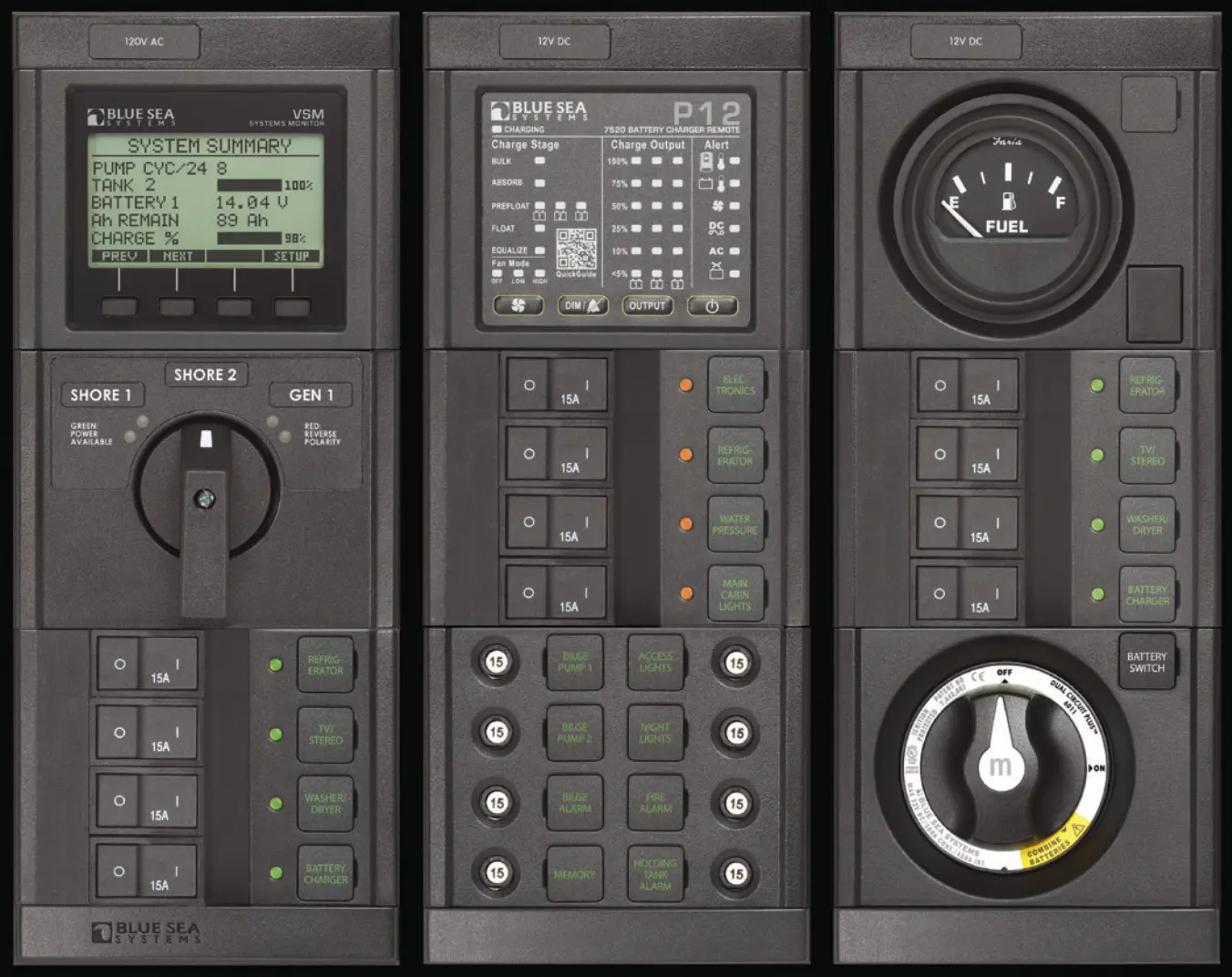
Circuit Breaker Panels
Marine circuit breaker panels group branch-circuit protection, switching, and electrical monitoring into an accessible distribution point. Options include Blue Sea Systems modular 360 panels, AC main and branch panels, DC switch-and-breaker panels, weather-resistant cockpit panels, and configurable source-selection layouts.
The right panel depends on AC versus DC service, circuit count, breaker sizes, available mounting space, and operator access. For exposed helms, consider a panel with an appropriate front-face water-resistance rating; for AC panels, review source selection, reverse-polarity indication, and main protection. Ward’s also manufactures and engraves custom electrical panels when an off-the-shelf layout does not fit the vessel.

Battery Chargers and Equipment
Marine battery chargers replenish and maintain starting and house battery banks from shore power or a generator. Ward’s catalog includes multi-stage AC battery chargers, multi-bank models, and charging accessories for 12V and 24V systems, with options for flooded lead-acid, AGM, gel, and compatible lithium batteries.
Start with battery chemistry, bank capacity (Ah), charging current, and the number of independently charged banks. Also check the available AC input voltage and frequency, temperature compensation, installation environment, and any MasterBus, CZone, or NMEA 2000 integration required. A charger must use the charging profile approved for the battery system.

Wiring Devices
Marine wiring devices create the removable connections and electrical access points used throughout a vessel. The catalog includes Deutsch multi-pin connectors, straight-blade and twist-lock plugs, receptacles, GFCI outlets, weatherproof covers, and Vimar international switches, plates, and mounting hardware.
For connectors, match pin count, contact size, wire gauge, sealing method, and operating current. For AC outlets, verify voltage, NEMA or international configuration, grounding, GFCI requirements, and suitable enclosure or cover protection. A multi-pin connector serves equipment wiring and harnesses, while a receptacle or plug serves a defined power interface; both require compatible mating components.

Wire and Cable
Marine wire and cable carry electrical power, control signals, and communications throughout a boat or yacht. Ward’s catalog includes tinned-copper primary and multi-conductor boat cable, battery and starter cable, low-smoke zero-halogen shipboard cable, shielded control cable, and NMEA 2000 and other communication cable.
Select conductor size from load current, circuit length, permitted voltage drop, and installation conditions—not just the rating of the connected device. Also check insulation temperature, wet-location suitability, flexibility, conductor count, shielding, and any applicable marine or class standards. Power cable, battery cable, and data-network cable serve different purposes and should be specified accordingly.

Windlass
Marine windlass electrical products operate and control the motors used to raise and lower an anchor. Ward’s catalog includes Quick deck switches, prewired control boxes, reversing contactors, handheld and wireless remotes, chain-counter components, and deck sockets and connectors.
Match replacement controls to the windlass motor voltage, power and current requirements, control wiring, and the number of functions needed. A reversing contactor handles motor direction; a deck switch or remote sends the operator command. Where chain counting is required, check sensor and display compatibility. Windlass power circuits also need properly sized wiring and overcurrent protection appropriate to the motor load.

Water Heaters
Marine water heaters provide stored hot water for onboard sinks, showers, and other domestic uses. Ward’s catalog lists Quick Nautic water heaters with electric heating elements and stainless-steel heat exchangers, along with replacement thermostats, heating elements, pressure-relief parts, and mixing-valve accessories.
Choose a unit based on tank capacity, physical mounting space, AC supply voltage, heating-element requirements, and compatibility with the vessel’s engine-heated coolant circuit where used. Also account for service access, pressure and temperature protection, and hot-water mixing. When replacing parts, match the exact heater model and voltage rather than relying on appearance alone.

Tools
Marine electrical installation and troubleshooting require tools suited to the conductor, terminal, and test being performed. Ward’s catalog includes Fluke test meters and clamp meters, inspection and thermal-imaging equipment, crimpers, cable cutters, wire strippers, heat guns, screwdrivers, and specialty termination tools.
For connections, match the crimp die or tool to the terminal and wire gauge; for heat-shrink work, use equipment that provides controlled heating. For diagnostics, select a meter with the required measurement range and appropriate electrical safety rating. The correct tool helps produce consistent terminations and makes electrical faults easier to isolate without unnecessary component replacement.

Switches
Marine switches provide hands-on control of lighting, motors, instruments, and auxiliary equipment. Options in the catalog include rotary selector and cam switches, sealed rockers, toggles, pushbuttons, keyed switches, and pilot-duty control devices for helms, switchboards, and machinery panels.
Choose the correct contact arrangement, number of poles, maintained or momentary action, and electrical load rating. For exposed stations, consider ingress protection, UV resistance, and ignition-protection requirements where applicable. Indicator illumination and custom-engraved actuators can make panel functions easier to identify. A switch operates a circuit; it should not be assumed to provide the overcurrent protection of a circuit breaker.

Transformers
Marine transformers provide electrical isolation, voltage adaptation, or shore-power voltage boosting, depending on the design. Ward’s catalog includes isolation transformers and intelligent shore-power boosting systems intended for yachts with varying dockside supply conditions.
Before selecting a transformer, confirm shore and vessel voltage, phase, frequency, continuous load, kVA rating, and available installation space. Isolation can help separate onboard power from the dock’s electrical system, while boost capability can compensate for certain low-voltage shore conditions. A conventional transformer does not convert 50 Hz to 60 Hz; that requires suitable frequency-conversion equipment. Shore-power grounding and protection should be engineered as a complete system.

Terminals and Devices
Marine terminals and connection devices create organized, serviceable electrical terminations throughout a vessel. The catalog includes DIN-rail terminal blocks, grounding terminals, bridging accessories, distribution bus bars, ring terminals, butt splices, ferrules, battery terminals, and adhesive-lined heat-shrink products.
Select by conductor size, current and voltage rating, termination method, mounting system, and exposure conditions. Properly matched crimp terminals and tooling are especially important where vibration and moisture are present. DIN-rail blocks simplify circuit tracing and replacement in control cabinets; sealed heat-shrink connections are useful where a wire splice needs additional moisture protection.

Shore Power
Marine shore-power equipment connects a vessel’s AC distribution system to an appropriate dockside supply. This category includes shore cords, twist-lock plugs and connectors, inlets, receptacles, weatherproof covers, adapters, cable-management systems, and high-current cam-lock devices. Ward’s also manufactures shore-power cords and adapters.
Before connecting, verify dock and vessel voltage, phase, frequency, amperage, connector configuration, and protective equipment. An adapter changes the physical connection but does not automatically make an incompatible supply safe. Larger yachts may require engineered paralleling, isolation, voltage boosting, or frequency conversion. Ward’s catalog includes a protected shore-power paralleling adapter for specific compatible configurations.

Solenoids
Marine solenoids and contactors let a control switch operate a higher-current electrical circuit. The catalog includes continuous-duty and intermittent-duty DC solenoids, series-paralleling contactors, and reversing contactors used with starting circuits, windlasses, capstans, and other motor loads.
Match coil voltage, contact arrangement, continuous or intermittent current rating, inrush current, and duty cycle to the application. A continuous-duty solenoid can remain energized for extended operation; an intermittent-duty unit is designed for shorter events and should not be substituted without checking the specification. Reversing contactors add directional motor control, while circuit protection must still be provided separately.

Switchboards
Marine switchboards bring power-source control, protection, metering, and distribution into a coordinated vessel electrical system. Ward’s designs and manufactures custom marine switchgear, including manual distribution systems, generator power-management arrangements, load-shedding controls, touch-screen interfaces, and associated monitoring and protection equipment.
Switchboard design begins with the vessel’s shore and generator sources, AC bus arrangement, load schedule, fault levels, control philosophy, and any class-society requirements. Options may include automatic generator addition and removal, blackout recovery, and remote operational visibility. Ward’s engineering and manufacturing teams can support new-build and refit projects that require more than a standard branch-circuit panel.

Relays and Timers
Marine relays and timers let a low-power control signal switch a separate circuit or trigger a timed action. The catalog includes plug-in and industrial relays, relay sockets, suppression modules, multi-function timers, and voltage-monitoring relays for alarms, pumps, sequencing, and machinery controls.
Choose by coil or control voltage, contact configuration (NO/NC), contact load rating, timing function, and mounting format. For inductive loads, review contact duty and coil suppression; for protective monitoring, confirm the upper and lower voltage thresholds and reset behavior. A timing relay controls when a load operates, while a protective relay responds to a defined electrical condition.

Pumps and Controls
Marine pumps and controls support automatic water removal and high-water monitoring, particularly in bilge systems. Ward’s catalog includes Rule electric bilge pumps, automatic float switches, auto/off/manual pump panels, electronic water-level switches, and alarm-capable pump controllers.
Compare pump capacity in gallons per hour, discharge size, operating voltage, wiring and fuse requirements, and the lift and hose routing of the installation. Select a switch with an appropriate current rating and on/off operating level. A manual override adds operational flexibility, while a separate high-water alarm can alert the crew when the primary pump or normal drainage is insufficient.

Power Conversion Equipment
Marine power-conversion equipment adapts electrical energy between onboard sources and loads. The catalog includes DC-to-AC inverters, inverter/charger systems, DC-to-DC converters, regulated power supplies, and marine shore-power frequency converters for vessels operating with different electrical supply standards.
Identify what must change: voltage, AC versus DC, frequency, or power quality. Then compare input range, continuous and surge output, load type, efficiency, cooling, and integration with batteries, generators, and shore power. An inverter powers AC loads from DC storage; a DC converter supplies a different DC voltage; a frequency converter addresses incompatible shore-power frequency and related power-conditioning needs.

Panel Meters
Marine panel meters display the electrical measurements operators need to check power conditions at a glance. The catalog includes digital and analog voltmeters, ammeters, frequency and power meters, ground-fault indicators, current transformers, and DC current shunts for AC and DC panels.
Choose a meter for the quantity being measured, measurement range, supply requirements, panel cutout, and display readability. Many ammeters require a correctly rated external current transformer or shunt rather than a direct high-current connection. Matching the sensor ratio and meter scale is essential for accurate readings. For network-wide data logging or remote dashboards, see digital automation and vessel-monitoring products.

Lights
Marine lighting serves several different functions: navigation and vessel-status signaling, crew task lighting, interior and exterior illumination, and visual indications on control panels. Ward’s catalog covers navigation-light systems and monitoring, utility fixtures, pilot lights, dimming controls, and architectural LED lighting options.
For navigation lights, choose equipment appropriate to vessel type, size, mounting position, and applicable visibility or classification requirements. For interior or deck lighting, compare voltage, light output, color temperature, beam angle, dimming compatibility, and ingress protection. A decorative LED fixture and a compliant navigation light are not interchangeable.

Motor Controls
Marine motor-control components start, stop, protect, and regulate electric motors used for pumps, compressors, ventilation, and vessel machinery. Ward’s catalog includes ABB and Schneider/Telemechanique contactors, overload relays, auxiliary contacts, interlocks, and variable-frequency drives.
Select equipment using motor voltage and phase, full-load current, starting method, duty cycle, and the required control-coil voltage. Overload relays must be matched and set for the motor; contactors must be rated for the load and switching duty. Variable-frequency drives offer adjustable motor speed where the motor and installation are suitable. These controls perform different jobs from branch-circuit overcurrent breakers.

Fuses
Marine fuses protect wiring and equipment by opening a circuit when current exceeds a defined limit. Ward’s catalog includes ATC/ATO and Maxi blade fuses, glass and ceramic cartridge fuses, ANL and other high-current power fuses, and specialty fast-acting or time-delay types.
Choose a fuse using the circuit’s voltage, expected operating and inrush current, conductor protection requirements, physical fuse format, and DC or AC interrupting rating. Fast-acting and time-delay fuses respond differently to brief surges, so they are not interchangeable simply because the amp rating matches. Always pair the fuse with a compatible holder and verify the installation’s available fault current.

Fuse Blocks and Holders
Marine fuse blocks and holders provide secure, serviceable mounting points for individual fuses or groups of protected circuits. The catalog includes in-line holders, panel- and DIN-rail-mounted fuse carriers, blade-fuse distribution blocks, battery-terminal fuse mounts, and high-current ANL and Class T fuse holders.
Choose the holder for the exact fuse family, system voltage, maximum current, conductor size, and installation location. A covered block can organize multiple DC branch circuits, while an in-line holder is useful for a single protected feed. The fuse determines the overcurrent protection characteristics; the holder must be correctly rated and compatible to support it safely.

Fans
Marine equipment fans move air through electrical cabinets, control spaces, and other areas where heat buildup can shorten component life. The catalog includes compact axial fans in multiple sizes, airflow capacities, and AC supply voltages for equipment ventilation applications.
Compare airflow in CFM, available mounting space, supply voltage, power draw, and operating temperature. Fan selection should also account for intake and exhaust paths; a fan cannot cool an enclosure effectively without a usable airflow route. Confirm the model’s environmental and ignition-protection suitability before installing it in any space where flammable vapors may be present.

DC Power Accessories
Marine DC power accessories create practical connection points for low-voltage equipment onboard. The catalog includes 12V power sockets and plugs, USB charging outlets, fishing-reel power connectors, and trolling-motor receptacles and plugs for dedicated high-current DC loads.
Identify the equipment’s operating voltage, current draw, connector type, and required wire size before choosing an outlet. A convenience USB socket and a trolling-motor receptacle have very different current and wiring requirements. For exposed deck or cockpit installations, consider sealing covers, corrosion-resistant contacts, secure strain relief, and the product’s environmental rating.

Enclosures
Marine electrical enclosures house and protect controls, junctions, terminals, and other components from the surrounding environment. Ward’s catalog includes fiberglass and polycarbonate junction boxes, windowed and hinged cabinets, receptacle boxes, distribution enclosures, and mounting accessories.
Choose an enclosure by internal component dimensions, cable-entry needs, access method, operating temperature, and the required IP or NEMA protection rating. Corrosion-resistant materials and proper gaskets matter in damp or exposed spaces, but the finished installation also depends on correctly rated glands and penetrations. Allow room for wiring bend radius, maintenance access, and heat generated by installed equipment.

Digital Automation
Marine digital automation connects onboard monitoring and control functions through networked modules, displays, sensors, and electronic switching. The catalog features systems from CZone, Böning, Mastervolt, and Maretron for managing circuits, batteries, generators, tanks, alarms, and other vessel operating data.
Choose an architecture based on what must be monitored or controlled, required inputs and outputs, onboard networks such as NMEA 2000 or MasterBus, and compatible displays. Digital switching can reduce conventional wiring and group multiple actions into operating modes, but integration depends on the specific components and protocols. For refits and new builds, system design should also address alarm behavior, manual overrides, and serviceability.

Circuit Breakers
Marine circuit breakers interrupt excessive current to protect wiring and equipment in AC and DC systems. The catalog covers compact thermal and magnetic-hydraulic breakers, DIN-rail and panel-mount designs, higher-capacity molded-case breakers, and equipment leakage circuit interrupters (ELCIs) for appropriate shore-power protection applications.
Match each breaker to the circuit’s voltage, AC or DC rating, number of poles, load characteristics, interrupting capacity, and available fault current. Trip curves matter for motors and other high-inrush loads; ELCI protection addresses leakage as well as overcurrent. A breaker must also fit its panel or mounting system and meet the applicable marine installation requirements.

Corrosion Control
Marine corrosion-control equipment helps diagnose and manage electrical conditions that can accelerate underwater metal loss. The catalog includes fail-safe galvanic isolators for shore-power grounding systems, cathodic-protection test kits and reference electrodes, and impressed-current cathodic-protection components.
A galvanic isolator addresses low-voltage galvanic currents carried on the shore-power safety-ground connection; it is not a remedy for every stray-current fault. Selection should consider shore-power current and fault ratings, grounding continuity, and the applicable ABYC requirements. For unexplained anode consumption or persistent corrosion, electrical and bonding-system testing should come before replacing components.

Cable Transit
Marine cable transit systems seal cable penetrations through bulkheads, decks, and equipment enclosures. Ward’s catalog includes Roxtec glands, modular sealing blocks, solid filler modules, compression wedges, stayplates, and installation accessories for single- and multi-cable entries.
Choose components by cable outside diameter, the number of cables, opening dimensions, and the required ingress-protection or class-approved assembly. Modular blocks can accommodate multiple cable sizes while allowing an orderly cable layout. Where a penetration forms part of a watertight or fire-rated boundary, verify that the complete installed transit—not just an individual component—meets the required specification.

Cable Support
Marine cable-support hardware keeps wiring secured, separated, and accessible despite vessel movement and vibration. The catalog includes cable ties, stainless-steel and cushioned clamps, adhesive-bonded mounts, studs, standoffs, aluminum cable tray, wire duct, cord grips, and cable-gland hardware.
Select supports for cable diameter, bundle weight, mounting surface, corrosion exposure, and service access. Cushioned clamps help limit vibration and chafe, while cord grips provide strain relief where a cable enters an enclosure. Trays and wire duct organize longer runs and panel wiring. Cable support controls the route and mechanical load; it does not replace conductor insulation or a rated watertight transit.

Cable Protection
Marine cable protection shields wiring where movement, chafe, sharp edges, or exposure could damage insulation. Available products include expandable braided sleeving, spiral wrap, split loom, edge molding, liquid-tight conduit, fittings, and support clips for protected cable runs.
Select protection according to cable bundle diameter, flexibility, heat exposure, abrasion risk, and resistance to UV, oil, or moisture. Split loom and spiral wrap allow access or wire breakouts, while conduit provides a more enclosed route. For cables passing through a watertight bulkhead, use an appropriately rated cable-transit sealing system rather than protective sleeving alone.

Batteries
Marine batteries supply starting power and stored energy for onboard DC loads. Ward’s catalog includes Mastervolt AGM and gel batteries as well as lithium iron phosphate (LiFePO4) models for applications that benefit from lower weight, usable capacity, and integrated monitoring.
Choose a starting battery for appropriate cranking capability and a house bank for the vessel’s daily energy use and expected discharge cycles. Compare amp-hour capacity, system voltage, dimensions, charging acceptance, weight, and installation conditions. A lithium replacement is not necessarily a drop-in substitute for lead-acid: confirm BMS integration, alternator and charger compatibility, and the manufacturer’s installation requirements.

Cable Identification
Marine cable identification products make electrical circuits easier to trace during installation, diagnostics, and future refits. Snap-on wire markers and preprinted marking books provide numbers, letters, polarity symbols, and circuit designations for conductors inside panels, junction boxes, and cable runs.
Choose a marker sized for the wire gauge or insulation diameter, and use a consistent numbering convention at both ends of each conductor. Clear identification reduces confusion when servicing densely wired switchboards and control panels, especially where multiple similar circuits terminate together. Cable identification labels the circuit; it does not replace abrasion protection or cable support.

Bow Thrusters
Bow thruster electrical parts and accessories help maintain responsive side-to-side maneuvering when docking or handling a vessel in tight quarters. This category includes Quick thruster propellers, replacement anodes, and joystick controls; the catalog lists components by compatible thruster series and propeller configuration.
When replacing a propeller or anode, confirm the exact thruster model, tunnel or drive specification, and, where applicable, left- or right-hand propeller orientation. For a control replacement, match the joystick to the installed thruster and control system. Correct component matching matters more than selecting by vessel size alone.

Battery Management
Marine battery-management components control how power moves between starting, house, and other DC battery banks. The catalog covers battery switches, automatic charging relays, battery isolators, redundant DC source selectors, shunt-based battery monitors, and distribution assemblies.
Use isolation and switching devices to keep house loads from unintentionally draining a starting bank; use monitoring to see voltage, current, state of charge, and power consumption. Select components by nominal system voltage, continuous and cranking current, number of banks, and charging arrangement. Battery management is not the same as a charger, and lithium installations may also require a battery-specific management system and compatible charging controls.

Alarms and Signaling
Marine alarms and signaling devices give crews audible or visual notice when equipment needs attention. The catalog includes panel buzzers, bells, illuminated warning devices, network-connected alarm modules, and monitoring/alarm units for conditions such as high bilge water, equipment faults, and system warnings.
Choose an alarm using supply voltage, sound level, visual indication, mounting size, environmental rating, and how its trigger signal is provided. Some devices are simple buzzers driven by a separate switch; others monitor inputs or communicate on NMEA 2000. For safety-critical warnings, confirm that the entire sensor-to-alarm arrangement is suitable for the intended application.
